Part of Fortune Calculator: Where Is My Part of Fortune?
The Part of Fortune is a calculated point in your birth chart that astrologers read as the area of life where gain and a sense of being supported come most easily. Type in the day you were born, the clock time and the town, and you get its sign, degree and house, with a short meaning for each. It checks whether you were born by day or by night and uses the matching formula. Using it costs nothing, and you do not need an account to see the result.
How to use it
- Enter the exact birth time. The Part of Fortune moves about two degrees every ten minutes, as fast as the Ascendant, so take the time from a birth record and check AM or PM.
- Choose your birth town. Select it from the suggestions as you type. The place sets the Ascendant and the local time zone, and both feed straight into the result.
- Read the sign, house and formula. The card shows the sign and degree, the house it falls in and a line for each. A note under it says whether a day or night formula was used.
Your Part of Fortune is the point that sits as far from your Ascendant as the Moon sits from the Sun. Born by day, it is Ascendant plus Moon minus Sun; born at night, the Sun and Moon swap places in the sum. You need a birth time, because the Ascendant changes sign about every two hours.
What the Part of Fortune is
The Part of Fortune, also called the Lot of Fortune or Fortuna, is not a planet. It is a point worked out from three things in your chart: the Ascendant, the Sun and the Moon. The distance from the Sun to the Moon is measured along the zodiac and then counted again from the Ascendant. Where that count ends is your Part of Fortune.
It is the best known of the Arabic Parts, or lots, a family of calculated points that goes back to Hellenistic astrology. Older astrologers tied it mostly to money, property and material well-being. Modern astrologers add natural talents and the kind of work that feels rewarding. Read it as the part of life where things tend to come to you with the least friction, not as a promise of wealth.
Day chart or night chart: why calculators disagree
There are two ways to work out the Part of Fortune, and this is the main reason two websites can give you different answers.
- Day formula: Ascendant + Moon − Sun. This is what William Lilly used in the 1600s for every chart, and many modern astrologers still use it for everyone.
- Night formula: Ascendant + Sun − Moon. The older Hellenistic and Arabic method switches to this when the Sun was below the horizon at birth.
This calculator follows the older day-and-night rule. If the Sun was above the horizon when you were born (houses 7 to 12), you have a day chart and the day formula is used. If it was below (houses 1 to 6), you have a night chart and the night formula is used. For a night birth, the card also tells you where the day formula would put it, so you can match the result against any other chart you have.
How much does the choice matter? We tested birth moments 97 minutes apart from 1990 to 2025 for New York, Los Angeles, London and Sydney, about 195,000 moments per city. In all four, close to half the births were night charts, and in about 92 percent of those night charts the two formulas land in different signs. So for roughly 46 percent of people, a calculator that ignores day and night shows another sign.
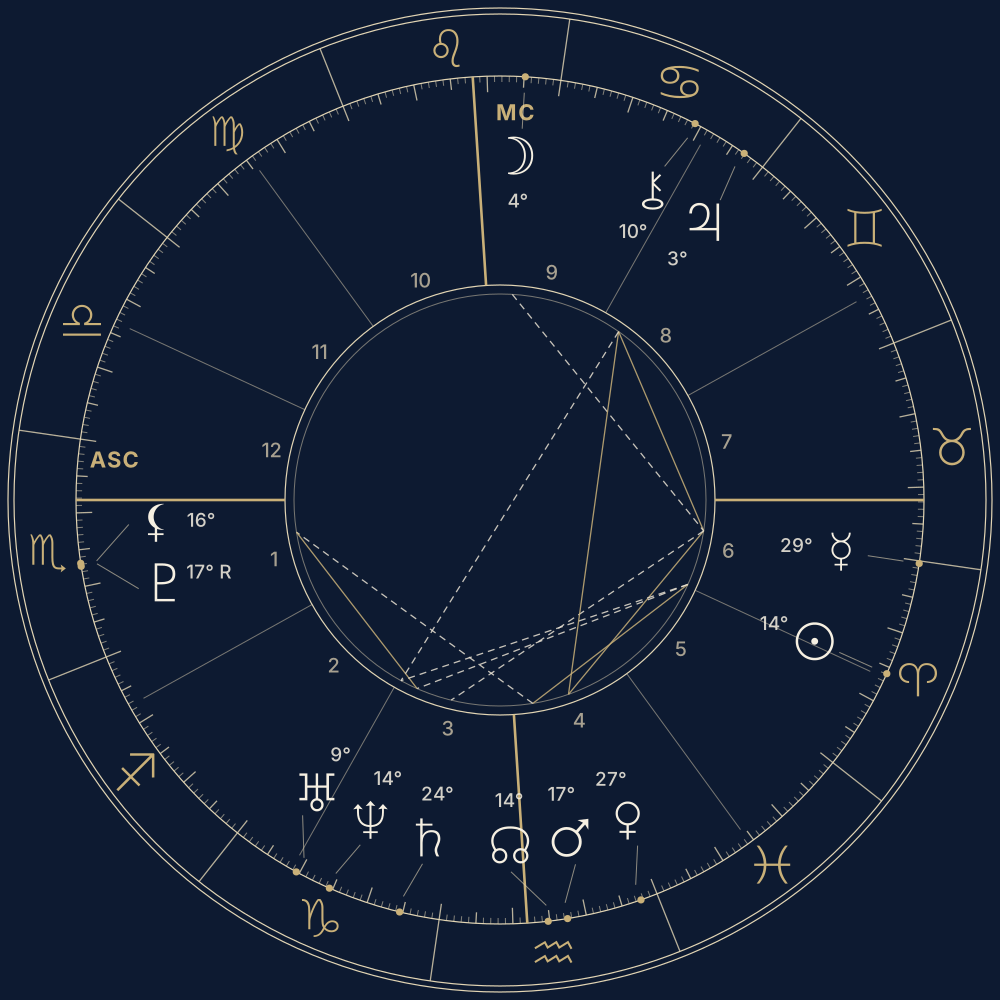
Here is one case. In New York on 15 May 1994 at 11:30 pm, the Sun was below the horizon. The night formula puts the Part of Fortune at 8 degrees Scorpio in the 10th house. The day formula would give 10 degrees Pisces instead. Born the same day at 2:30 pm, with the Sun above the horizon, the person has a day chart and a single answer: 16 degrees Scorpio in the 3rd house.
Why it needs a birth time
The Ascendant passes through every sign in roughly 24 hours, and the Part of Fortune moves with it. In that four-city test, the middle value was about two degrees for each ten-minute shift in the birth time, and roughly 1 time in 10 the sign changed within that shift. Births near sunrise and sunset are the most sensitive, because a few minutes can switch a chart from night to day and change the formula itself.
Unsure of the time? The Moon sign and Sun sign are far less sensitive. The Part of Fortune and the Rising sign are not.
Reading the sign and the house
The house is usually the first thing to look at. It names the area of life involved: the 2nd house is money you earn and things you own, the 7th is working one-to-one with others, the 10th is your public role and the goals you are known for. The sign then describes the way that area works best for you, for example through patience in Taurus or through research in Scorpio.
The calculator places the Part of Fortune in the same house system as your full chart, Placidus unless you switch. Some traditional astrologers read it in whole sign houses, so a point close to a house cusp may sit one house over in their chart.
Getting your Part of Fortune right
- Take the time from your birth certificate rather than from memory. Ten minutes can move the point into the next sign.
- If you were born within half an hour of sunrise or sunset, check whether the card says day chart or night chart. That decides which formula you get.
- Comparing with another site? Look at the day formula line on the card first. Most differences come from that choice, not from an error.
- A result in the first or last degree of a sign is borderline. Read both signs and see which fits.
- Look at the planet that rules the Part of Fortune's sign in your full chart, since astrologers read the two together.
For a second point found from the same details, try the Vertex calculator. Every position here is checked as described on how we calculate.
Common questions
What is the Part of Fortune in astrology?
It is a calculated point found from your Ascendant, Sun and Moon: it sits as far from the Ascendant as the Moon sits from the Sun. Astrologers read its sign and house as the area where gain, ease and a feeling of being supported tend to come to you most naturally.
How do you calculate the Part of Fortune?
For a day birth, add the Moon's position to the Ascendant and subtract the Sun's. For a night birth, add the Sun and subtract the Moon. Positions are counted in degrees from 0 Aries, and you remove 360 if the total goes over. The calculator does this and picks the formula for you.
Why is my Part of Fortune different on another website?
Usually because of the formula. Many calculators use the day formula for every chart. If you were born at night, this calculator uses the night formula and shows the day formula result underneath, so you can see whether that explains the gap. A different birth time or time zone is the next thing to check.
Can I find my Part of Fortune without a birth time?
No. The Part of Fortune is counted from the Ascendant, which changes sign about every two hours, and the time also decides whether you have a day or a night chart. Without a time, the calculator asks you to add one instead of guessing.
Is this Part of Fortune calculator free?
Yes, all of it costs nothing: sign, degree, house and the short meanings. No account and no app; your browser does the arithmetic from what you type.
What house is my Part of Fortune in?
The card names the house. It uses the same house system as your full chart, which is Placidus unless you change it. If the point sits close to a house cusp, a whole sign chart may put it in the next house.
Is a day chart or night chart better for the Part of Fortune?
Neither is better. Day or night only decides which formula is used. A day chart means the Sun was above the horizon at birth, in houses 7 to 12; a night chart means it was below, in houses 1 to 6. About half of all births are each.
Does the Part of Fortune mean I will be rich?
No. Older astrologers linked it to money and possessions, but it does not predict an amount or an outcome. Read it as the area of life where effort tends to pay off more easily for you, and treat it as one point among many in your chart.