Vertex Calculator: What Is My Vertex Sign in Astrology?
The Vertex is a calculated point on the western side of your birth chart, near the Descendant, that astrologers link to meetings and turning points you did not plan. Give the calculator your birth date, the clock time and the town, and it shows your Vertex sign, its degree and the house it falls in. You need the birth time; the result is free and needs no account.
How to use it
- Enter the exact birth time. The Vertex moves about two degrees every ten minutes, so use the time on your birth record and double-check AM or PM.
- Select the exact town. Choose your town from the suggestions. The Vertex depends strongly on latitude, your distance from the equator, so the right town matters.
- Read your Vertex. The card shows the Vertex sign and degree and the house it sits in, with a short note on how astrologers use the point.
Your Vertex is the point where the Sun's yearly path crosses the great circle through east, overhead and west, on the western side of your chart. It needs your exact birth time and place, and it almost always falls in the 5th, 6th, 7th or 8th house.
What the Vertex is
The Vertex is not a planet or an asteroid. It is a point found from the shape of the sky over your birthplace. Picture two great circles. One is the ecliptic, the Sun's yearly path, which the zodiac signs are laid along. The other is the prime vertical, a circle that runs from the east point up through the point straight overhead, down to the west point and on under your feet. The two circles cross in two places. The crossing on the western side is your Vertex.
Because it sits on the western side, the Vertex lies in the same part of the chart as the Descendant, the start of the house of partners. Some astrologers call it a fifth angle, after the Ascendant, Descendant, Midheaven and IC, but a minor one. The point directly opposite it, on the eastern side, is sometimes called the Anti-Vertex.
What astrologers use it for
Astrologers who work with the Vertex connect it with encounters and turning points that come without being planned, the kind that feel bigger than a personal choice. It is used most often when comparing two charts, where one person's planet or Ascendant lying on the other person's Vertex is read as a strong link.
Its meaning is debated more than most points, and some astrologers give it no weight at all. We have not found sourced interpretations for the Vertex in each sign or each house that meet our standard, so the calculator gives you the position and the general meaning, not a sign-by-sign reading.
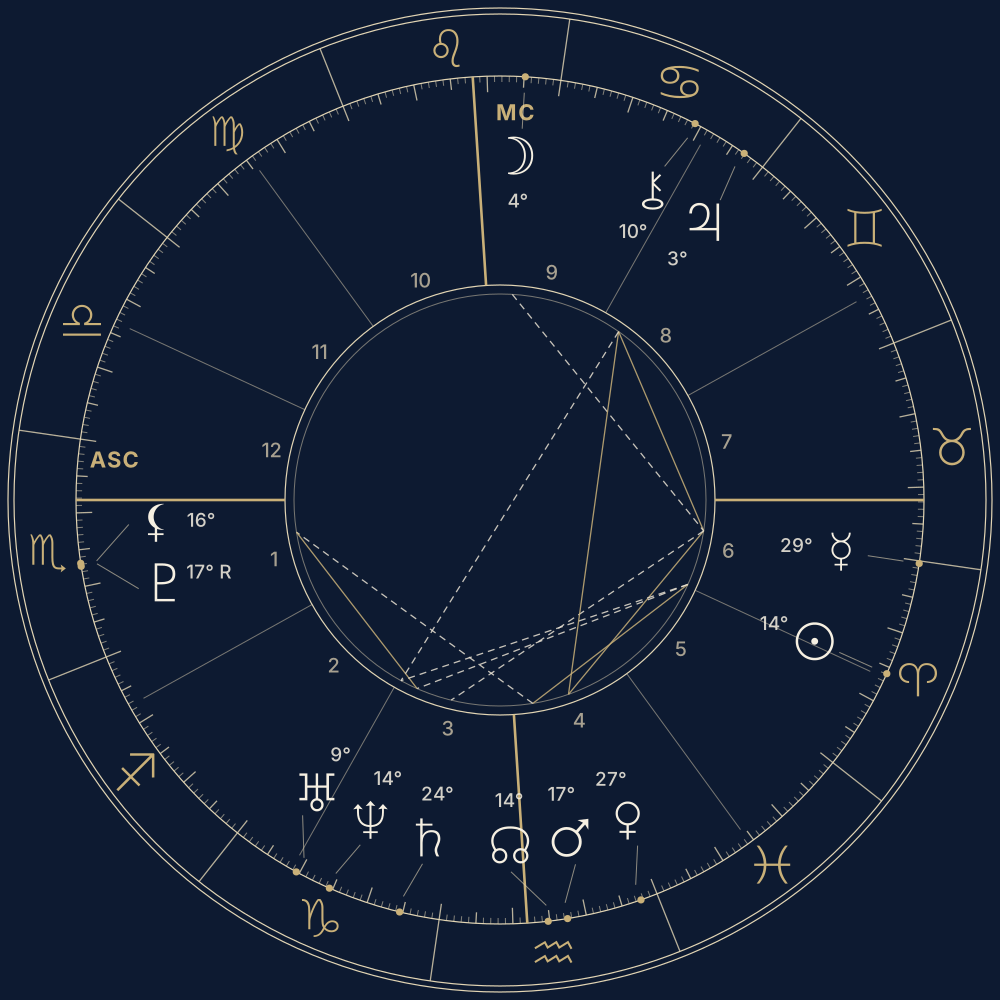
Where your Vertex can fall
Our test covered a birth moment every 97 minutes across 36 years, 1990 to 2025, in each of four cities (Sydney, London, New York and Los Angeles), about 195,000 moments per city with Placidus houses. In every single case the Vertex fell in the 5th, 6th, 7th or 8th house, the four houses around the Descendant. So if another chart shows your Vertex in the 2nd or 11th house, check the birth time and the place before anything else.
The signs are not equally common either, because the Vertex depends on latitude. In New York, Leo, Virgo, Libra and Scorpio each came up in about 11.5 percent of births, while Aries and Pisces came up in only about 4 percent. In Sydney the pattern turns around: Aries, Taurus, Aquarius and Pisces were the common ones, and Libra and Virgo the rare ones, under 3 percent each.
Why it needs a birth time and the right place
Like the Ascendant, the Vertex goes round the whole zodiac every day. In the same test, a typical ten-minute shift in birth time moved it about two degrees, and about 1 birth in 12 got a new sign from that shift. Here is New York on 15 May 1994: born at 2:30 pm, the Vertex is at 2 degrees Pisces in the 6th house; born at 11:30 pm the same day, it is at 18 degrees Leo in the 7th house.
The birthplace matters more than for most points. The Vertex is worked out from the latitude as well as the local time, and near the equator it behaves erratically, so choose the actual town rather than the nearest big city. With only an approximate time, start with your Moon sign instead.
Checking your Vertex
- A time rounded to the nearest hour can shift the Vertex a whole sign, so use the recorded minute.
- Check the degree. Within a degree of either end of a sign, the next-door sign could be yours.
- If your Vertex is in the 5th or 8th house, it may sit near the edge of the house; in whole sign houses it can land in the neighbouring one.
- Look at what else is near it in your full chart: a planet within a degree or two of the Vertex is what astrologers notice first.
- Your Rising sign uses the same birth details and sits directly opposite the Descendant, so you can read the two sides of your chart together.
The Part of Fortune calculator needs exactly the same details. Our position checks are described under how we calculate.
Common questions
What is the Vertex in astrology?
It is the point where the ecliptic, the Sun's yearly path, crosses the prime vertical on the western side of your birthplace's sky. It lies near the Descendant, and astrologers who use it link it to unplanned meetings and turning points, especially in relationships.
How do I find my Vertex?
Enter your birth date, exact birth time and birthplace above. The calculator works out the local sidereal time and your latitude, finds where the two circles cross in the west, and shows the sign, degree and house. You need the birth time; a date alone is not enough.
What house is my Vertex in?
The card names the house. In our run over 1990 to 2025 in four cities, the Vertex always landed in the 5th, 6th, 7th or 8th house with Placidus houses. If a chart shows it far from the Descendant, check the birth time and place.
How fast does the Vertex move?
About as fast as the Ascendant, a full circle of the zodiac each day. Ten minutes usually moves it about two degrees, and in our four-city test roughly one birth in twelve changed Vertex sign over those ten minutes.
Is the Vertex calculator free?
Yes. There is no charge for the result and no sign-up or download. The calculation runs in your browser from the birth details you type in.
Is the Vertex the same as the Descendant?
No. The Descendant is where the ecliptic meets the western horizon. The Vertex is where it meets the prime vertical, a different circle, so it usually sits some way from the Descendant, in one of the four houses around it.
What is the Anti-Vertex?
It is the point exactly opposite the Vertex, on the eastern side of the chart near the Ascendant. Take your Vertex sign and degree and go to the same degree of the opposite sign. For example, a Vertex at 18 degrees Leo puts the Anti-Vertex at 18 degrees Aquarius.
Why does my Vertex sign look rare?
Because the signs are not equally likely. The Vertex depends on latitude, so in New York, Leo to Scorpio are common and Aries and Pisces are rare, while in Sydney the pattern is reversed. A rare sign is not more or less meaningful.